
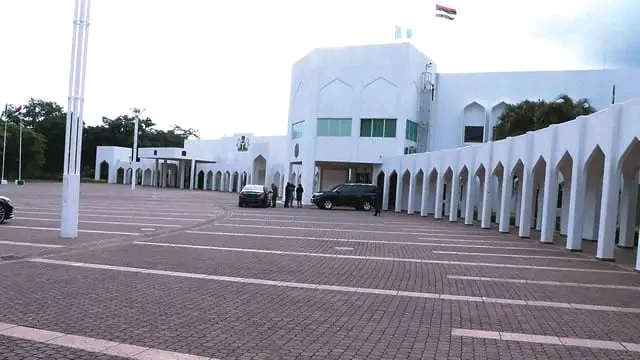
The Aso Rock Presidential Villa will disconnect entirely from the national electricity grid by March 2026 as it concludes the transition to a solar-powered mini grid, the Permanent Secretary, State House, Temitope Fashedemi, has revealed.
Fashedemi disclosed this on Wednesday while defending the State House’s 2026 budget before the Senate Committee on Special Duties at the National Assembly in Abuja. Details of the session were later made available to State House correspondents by the Presidency.
According to him, the solar power installation was completed toward the end of 2025 and has been undergoing testing since December. He expressed optimism that a full transition would be achieved by March.
“We are hopeful that maybe by March we’ll be able to do a full cutover,” he told lawmakers, noting that the project is expected to significantly reduce government expenditure on electricity.
He cited the State House Medical Centre as evidence of the project’s effectiveness, stating that the facility has operated solely on solar power since May 2025 without relying on generators.
“Since that time, the generator in that State House Medical Centre has not been put on for one minute since May last year,” Fashedemi said. “Only a couple of months, we used three per cent from AEDC, so the rest has been strictly from the solar and from the battery electric storage system.”
The Federal Government earmarked N10 billion in the 2025 budget for the “Solarisation of the Villa with Solar Mini Grid” project, a move that attracted criticism from some Nigerians who viewed it as an acknowledgment of the country’s persistent power supply challenges.
The 2026 Appropriation Bill proposes an additional N7 billion allocation to complete the project.
Defending the initiative earlier in April 2025, the Director-General of the Energy Commission of Nigeria, Mustapha Abdullahi, argued that it was financially unsustainable for the Villa to continue paying an estimated N47 billion annually in electricity costs.
Similarly, the President’s Special Adviser on Information and Strategy, Bayo Onanuga, had referenced the White House’s adoption of solar energy as a precedent for the decision.
Before the commencement of the solar transition, the State House had accumulated electricity debts approaching N1 billion. In February 2024, the Abuja Electricity Distribution Company (AEDC) listed the Presidential Villa among top government debtors, citing an outstanding bill of N923.87 million.
Fashedemi further disclosed that the ongoing testing phase had uncovered cases of alleged overbilling by AEDC, including instances where transformers billed for electricity not supplied.
“What we have discovered in the course of all of this, especially during the testing phase, is that there’s been a lot of overbilling,” he said. “We are using that period now to point it out to them and hopefully do some reconciliation about this legacy liability.”
